
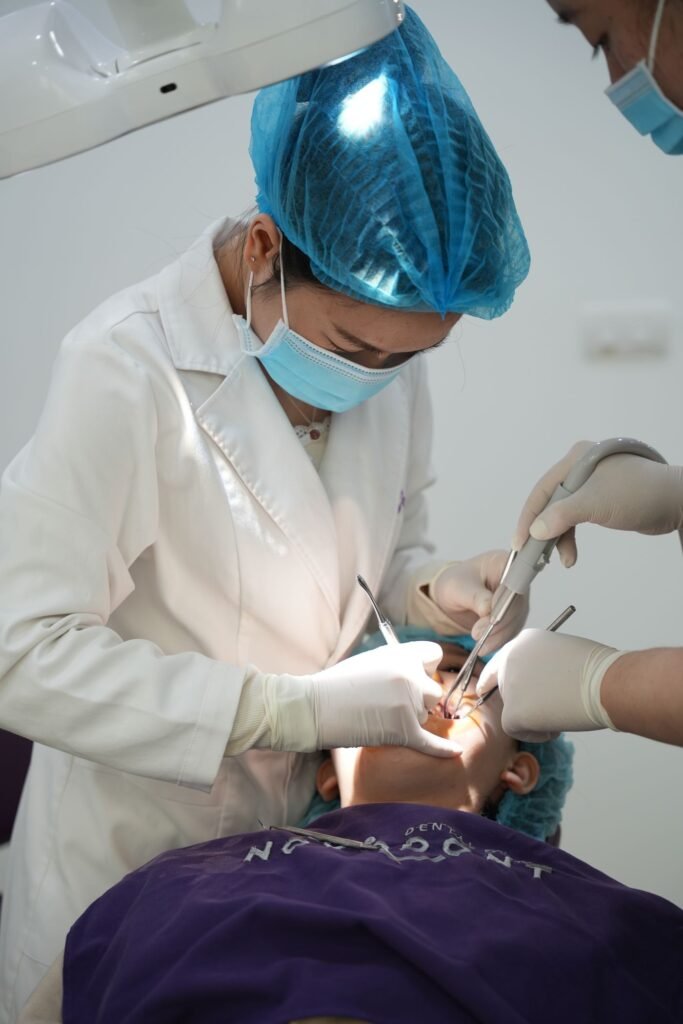
A general dentist handles most of your dental care, from checkups and fillings to crowns, root canals and simple extractions. An oral and maxillofacial surgeon is a dental specialist with 4 or more extra years of hospital-based surgical training, focused on complex procedures like impacted wisdom teeth, bone grafts, jaw surgery and facial injuries. Many tooth removals and implant procedures can be done by either, and your dentist decides when oral surgery by a specialist is the safer choice.
Needing “oral surgery” sounds alarming, but most procedures under that name are routine. Pulling a tooth is technically oral surgery. So is placing an implant.
The real question is complexity. A straightforward extraction is often done right at a dental clinic in Toronto like Honey Smile Dentistry. A wisdom tooth wrapped around a nerve, or a jaw that needs realigning, belongs with a specialist.
Implants sit in the middle. Many general dentists with advanced training place dental implants every week, while cases needing major bone grafting or sinus lifts may be shared with a surgeon.
Either way, your path usually starts with your regular dentist through general and family dentistry, who sees the full picture and coordinates the plan. And if you’re in pain right now, an emergency dentist in North York can assess you and decide on the next step the same day.
Dentist vs oral surgeon at a glance
| General dentist | Oral and maxillofacial surgeon | |
|---|---|---|
| Training after university | 4 years of dental school | Dental school plus 4 to 6 years of hospital surgical residency |
| Focus | Overall oral health, prevention, restoration | Surgery of the mouth, jaws and face |
| Typical procedures | Exams, cleanings, fillings, crowns, root canals, simple extractions, many implants | Impacted wisdom teeth, complex extractions, bone grafts, jaw surgery, facial trauma, biopsies |
| Sedation and anaesthesia | Local anaesthetic; many offer nitrous or oral sedation | Wide range, including IV sedation and general anaesthesia |
| Where they work | Dental clinics | Specialist offices and hospitals |
| Ontario regulation | Registered with RCDSO | Registered with RCDSO as a specialist |
What does a general dentist do?
A general dentist is your main oral health provider. They:
- Examine teeth, gums, jaw and soft tissues
- Take and read X-rays
- Clean teeth and treat early gum disease
- Fill cavities and place crowns, bridges and veneers
- Do root canal treatment
- Remove teeth, including many wisdom teeth
- Place implants, with additional training
- Provide dentures and night guards
- Screen for oral cancer
Many general dentists take extra courses in implants, sedation or cosmetic dentistry, so their scope varies from clinic to clinic.
What does an oral surgeon do?
An oral and maxillofacial surgeon handles procedures that need advanced surgical skill or hospital-level anaesthesia:
- Impacted or complex wisdom teeth, especially near nerves or sinuses
- Difficult extractions, like curved roots or teeth broken below the gum
- Bone grafts and sinus lifts to prepare for implants
- Corrective jaw surgery for bite or facial balance problems
- Facial injuries, such as fractured jaws or cheekbones
- Cysts, tumours and suspicious lesions, including biopsies
- TMJ (jaw joint) surgery for severe cases
- Cleft lip and palate surgery, often with a hospital team
When will your dentist refer you to an oral surgeon?
Common reasons include:
- A wisdom tooth that’s deeply impacted or sitting on the nerve
- Medical conditions that make surgery higher risk
- Needing general anaesthesia for a procedure
- Major bone loss before implants
- A suspicious lump, patch or sore that needs a biopsy
- Jaw or facial injuries
- A bite problem that braces alone can’t fix
A referral doesn’t mean something is wrong with your dentist’s skills. It means the case needs a specialist’s tools or training.
What to expect when you see an oral surgeon
- Referral and records. Your dentist sends X-rays and notes.
- Consultation. The surgeon reviews your history, examines you and may take a 3D scan.
- Plan and consent. You’ll hear the options, risks and recovery time, plus the anaesthesia choice.
- Pre-surgery instructions. Fasting, medication changes and a ride home if sedated.
- Procedure day. Often 30 to 90 minutes for common procedures.
- Recovery. Usually a few days of swelling and soft foods for extractions.
- Follow-up. A check with the surgeon, then your regular dentist continues care.
Which procedures can either one do?
| Procedure | General dentist | Oral surgeon |
|---|---|---|
| Simple extraction | Yes | Yes |
| Erupted wisdom tooth removal | Often | Yes |
| Impacted wisdom tooth removal | Sometimes | Yes |
| Single implant in good bone | Often, with training | Yes |
| Implant with major bone graft | Sometimes shared | Yes |
| Biopsy of a lesion | Sometimes | Yes |
| Jaw surgery | No | Yes |
Typical recovery after common oral surgery procedures
| Procedure | Usual downtime | Soft food period | Notes |
|---|---|---|---|
| Simple extraction | About 1 day | 2 to 3 days | Mild soreness, minimal swelling |
| Surgical or impacted wisdom tooth removal | 2 to 4 days | About 1 week | Swelling peaks around day 2 or 3 |
| Single implant placement | About 1 day | About 1 week | Chew on the other side for weeks |
| Bone graft or sinus lift | 2 to 3 days | 1 to 2 weeks | Extra care with nose blowing after sinus lifts |
| Biopsy | Same day | 1 to 3 days | A few stitches, results in 1 to 2 weeks |
Everyone heals at their own pace. Smoking, uncontrolled diabetes and some medications can slow healing, so share your full health picture before surgery.
Does sedation differ between a dentist’s office and a surgeon’s office?
Often, yes. Many general dentists offer local anaesthetic plus nitrous oxide or oral sedation, which suits most routine procedures. Oral surgeons are trained to provide deeper IV sedation and general anaesthesia, with monitoring equipment and staff to match.
Deeper isn’t always better. The right level depends on the procedure, your health and your anxiety, and lighter options mean a faster recovery and fewer side effects.
Real patient scenarios
The routine extraction. A man needed a broken premolar removed. His general dentist did it in 20 minutes with local anaesthetic. He was back at work the next day.
The tricky wisdom tooth. A 19-year-old’s lower wisdom tooth sat directly on the nerve canal on a 3D scan. Her dentist referred her to an oral surgeon, who planned a careful removal under IV sedation.
The implant team. A woman had lost bone after an old extraction. The surgeon placed a bone graft, and 4 months later her dentist placed the implant and crown.
Common mistakes patients make
- Assuming every tooth removal needs a specialist (many don’t)
- Refusing a referral to save time when the case is complex
- Skipping the follow-up with your regular dentist after surgery
- Not mentioning medications like blood thinners or bone-strengthening drugs
- Ignoring post-op instructions on smoking and straws
Myths about oral surgery and dental anxiety
“Oral surgery is extremely painful.” Procedures are done under local anaesthetic or sedation. Discomfort afterward is usually manageable for a few days.
“An oral surgeon is just a dentist who pulls teeth.” Surgeons train for years in hospitals, managing complex surgery and anaesthesia.
“If I’m nervous, I have to go to a specialist.” Many general dentists offer nitrous oxide or oral sedation for anxious patients.
Safety note: After any oral surgery, call your provider if bleeding doesn’t slow with pressure after a few hours, swelling worsens after day 3, you develop a fever, or numbness doesn’t wear off. Trouble breathing or swallowing needs emergency care.
How to prepare for oral surgery
- Share your full medical history and medication list
- Arrange a ride if you’ll be sedated
- Stock soft foods: yogurt, soups, mashed potatoes
- Plan 1 to 3 days of rest for extractions
- Avoid smoking and vaping before and after surgery
- Follow fasting instructions exactly
How to choose a clinic in Toronto for oral surgery
Look for a team that explains whether your case can be handled in-office or needs a specialist, uses 3D imaging when needed, offers sedation options, and stays involved in your follow-up. All providers should be registered with the Royal College of Dental Surgeons of Ontario (RCDSO).
Honey Smile Dentistry is a premium boutique dental clinic in North York Toronto, focused on comfort, advanced technology and personalized care. The welcoming, sophisticated clinic at 12 Inn on the Park Dr, Toronto, ON, Canada, M3C 0P9 offers oral surgery, implants, sedation, dentures, teeth whitening, cosmetic dentistry and general preventive care.
New patients are welcome. You can book online, call +1 437-525-2715, or email info@honeysmiledentistry.ca. Same-day appointments are often available for urgent problems.
This article is general information. Whether you need a general dentist or a specialist depends on an examination and imaging by a licensed dentist, with proper follow-up after any procedure.
Frequently asked questions
Can a regular dentist remove wisdom teeth?
Yes, many general dentists remove wisdom teeth, especially erupted or mildly impacted ones. Deeply impacted teeth near nerves are often referred to an oral surgeon.
Is an oral surgeon a doctor?
Oral and maxillofacial surgeons are dentists with extensive hospital-based surgical training. Some also hold a medical degree.
Do I need a referral to see an oral surgeon?
Many oral surgeons accept self-referrals, but most patients are referred by their dentist, who shares X-rays and records.
Can a general dentist place dental implants?
Yes. Many general dentists with advanced training place implants. Complex cases with major bone loss may involve a surgeon.
Is oral surgery done under general anaesthesia?
Some procedures are, but most use local anaesthetic, sometimes with nitrous oxide, oral sedation or IV sedation.
Conclusion
Your general dentist handles most care, including many extractions and implants.
An oral surgeon steps in for complex cases that need advanced surgical training or deeper anaesthesia.
Starting with your dentist ensures you get the right provider for your exact situation.